- How does the District balance the budget?
Municipalities are required by the Provincial legislation to balance their budgets, which means that all budgeted expenditures must have revenues in place to cover them.
After looking at all other sources of revenue, the cost of providing the desired services must be balanced with a tax increase that the community can afford at any one time.
- What is the operating budget?
The operating budget funds the ongoing operations of assets residents and businesses use, such as streets, parks, trails and cultural and recreational programs, and provides services such as police and fire. The majority of costs are wage-related, along with operating costs for District of West Vancouver facilities.
West Vancouver’s challenging geography impacts the cost of essential services compared to other municipalities.
After accounting for all other revenues, the cost of these services is funded through property taxes.
- What is the capital budget?
West Vancouver, like almost every municipality in Canada, has ageing infrastructure that requires a long-term plan and financial resources to repair, maintain, and replace assets. This includes everything from community centres and the Seawalk to park benches, streets, and sidewalks.
The capital budget provides funds for maintenance and replacement of infrastructure, such as roads, District facilities, and parks and trails.
Capital projects are prioritized by Council and outlined in their Strategic Plan. The majority of capital projects are funded by the Asset Levy.
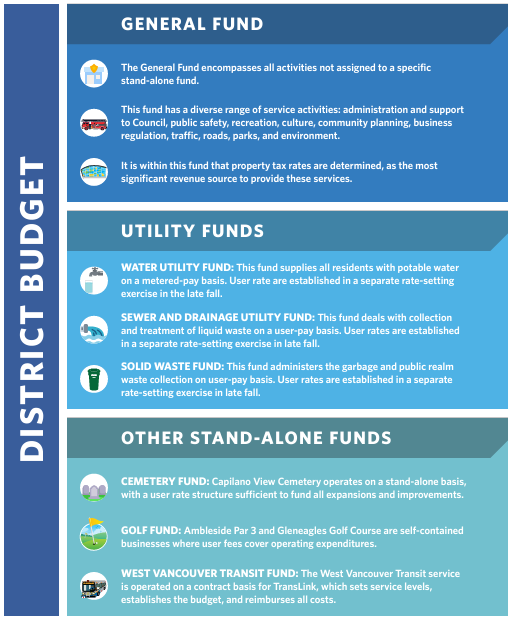
- What makes up the District’s budget?
The District’s consolidated budget is made up of the individual budget of various funds. Each fund is a stand-alone business entity that engages in specific service activities and has its own particular revenues, expenditures, reserves and capital program. Each fund also has its own particular approach to budgeting and rate setting.
- How is the District's capital budget developed?
Capital budgeting is a long-term planning process, aligned with the District’s asset management plan. It starts with a comprehensive review and analysis of all existing District’s capital assets, projecting maintenance and replacement costs over a 20-year period, ensuring our capital assets remain at their optimal level.
This annual asset management groundwork forms the basis for capital budget requests.
- What factors influence the development of the budget?
The budget process, and the decisions that must be made on how to best lead the development of a safe, vibrant and sustainable city, are supported by the following plans:
- Official Community Plan
- Asset Management Plan
- Council Strategic Plan
- What is the focus for the District's 2024 Budget?
The focus of the 2024 Budget is on:
- Restoring the asset reserves to keep the current District's assets at their optimal levels;
- Improving the delivery of core services to the residents and businesses within the District;
- Aligning the budget with Council's new strategic priorities; and
- Maintaining the District's long-term fiscal sustainability and resilience.
- What falls under the category of “General Government?” Could you provide a breakdown of expenses within this category?
The General Government category contain costs that are not directly attributable to a service area. It includes a provision for wage settlements, legal costs, insurance, fiscal services (e.g. debt repayment, transactional fees for payment systems and interest for tax prepayments), grants in aid program, one-time initiatives that are funded from reserves and grants, provision for election/by-election, third party works that are fully recoverable from the third party, transfer of revenue earned or grant funding received to various reserves, allocation of tax revenue to the Ambleside Dundarave Business Improvement Association per the bylaw and a provision for employer paid costs (fringe benefits: EI, CPP, WCB, Employer Health Tax) included in total compensation.
There may be certain requirements tied to provincial grants received by the District that obliges the District to transfer the funds to designated reserves to be used for eligible projects, like the one-time Growing Communities Fund of $8 million in 2023. Also, the provisions for wage settlements, election/by-election and employer paid costs (fringe benefits) are funded from their associated operating reserve.
The table below provides a detailed breakdown of inclusion in the three 2024 Budget Options and 2023 Approved Budget.

- In the presentation, an amount of $.02 M was mentioned for "homelessness camp". What is meant by "homelessness camp" and how is the $.02M going to be spent?
Since the COVID-19 pandemic, the District of West Vancouver (“District”) has seen a notable increase in encampments of people who are experiencing homelessness. The cleanup of these camps, including the removal and disposal of associated garbage and hazardous materials needs to be performed by experienced contractors. Originally, this work was covered by the provincial COVID Safe Restart Grant, but that grant has since expired. The proposed $.02 million is intended for compensating contracted services.
The cleanup is required to prevent the expansion of these sites, safeguarding the health and safety of the public and environment. It aims to enhance the viability of certain areas and parks in the District while ensuring that people who are unhoused or underhoused and are associated with these sites are given contacts and access to the appropriate supports. It also aims to mitigate potential escalation to the West Vancouver Police and reduce the viability of encampment areas to wildlife. The District has, and anticipates ongoing, expenditures for the cleanup of these encampments. These cleanups can occur in accessible areas or more remote parts, which can complicate the work and impact the cost.