

Sponsored by PARC Retirement Living
The Ferry Building Gallery is delighted to present Tam Irving’s Dimensions, an exhibition of work sitting at the intersection of colour, form, and perception—where the boundaries between painting, object, and optical experience begin to dissolve.
Long recognized as a master potter, Irving turns here to a broader visual language, extending his practice beyond function and into a sustained inquiry into the relationship between art and craft.
At the heart of the exhibition is a rigorous exploration of colour: its capacity to create tension or harmony, to advance or recede, to unsettle or resolve. Drawing on the legacy of colour field painters such as Mark Rothko and Barnett Newman, Irving examines how subtle shifts in hue and contrast can produce spatial effects.
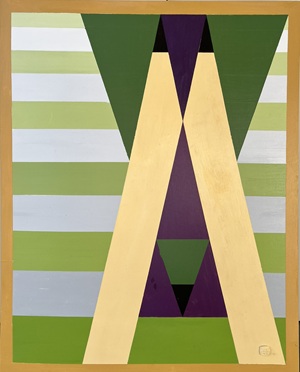
This investigation is paired with an equally probing study of form. Circles are cut, folded, layered, and interrupted; vessels are reimagined and surfaces deceive. Objects that appear flat reveal themselves as dimensional, while others hover ambiguously between two and three dimensions. Irving approaches these transformations with the precision of a scientist, dissecting and reconstructing shapes to test their limits. The result is a playful yet exacting visual language, where perception itself becomes unstable.
The work draws from early 20th-century abstraction, particularly the structural clarity of Lyubov Popova and the Constructivist ethos of building compositions through colour and line. Echoes of Kazimir Malevich’s Suprematism and the spiritual minimalism of Hilma af Klint surface in Irving’s restrained yet deliberate use of form and palette. There are also resonances with the quiet, contemplative grids of Agnes Martin and the gestural freedom of Jackson Pollock—though Irving’s work remains distinctly his own, grounded in materiality and objecthood.
About the artist:
Tam Irving was born in 1933 in Bilbao, Spain. Part of his childhood was spent in Portugal, where traditional earthenware first stimulated his interest in ceramics. This early interest was set aside for what he deemed more serious vocational pursuits while he studied at Edinburgh University, Scotland, receiving a B.Sc. degree in 1956. That same year, he emigrated to Canada and worked for seven years as a chemist with Shell Canada.
Finding little fulfillment in this work, he left the industry in 1964 and returned to his first love, clay. He studied at the Winnipeg School of Art, Haystack Mountain School of Crafts, and the Vancouver School of Art. Feeling that what he truly needed was to make pots, he cut short further academic study and established a studio in Vancouver in 1966, where he earned a living as a production potter for the next seven years.
In 1973, he began teaching at the Vancouver School of Art, which matured into a full-time teaching career at Emily Carr University of Art and Design. He retired from the Institute in 1996 to return to his own practice. Moving toward hand-built pieces, he extended his clay practice by producing sculptural forms and “Still Life” compositions.